
How AI Lets a Small Business Do What Used to Require a Big Team
Five years ago, small businesses needed to hire teams to match enterprise output. AI has changed that equation by handling volume work, letting lean teams punch above their weight.

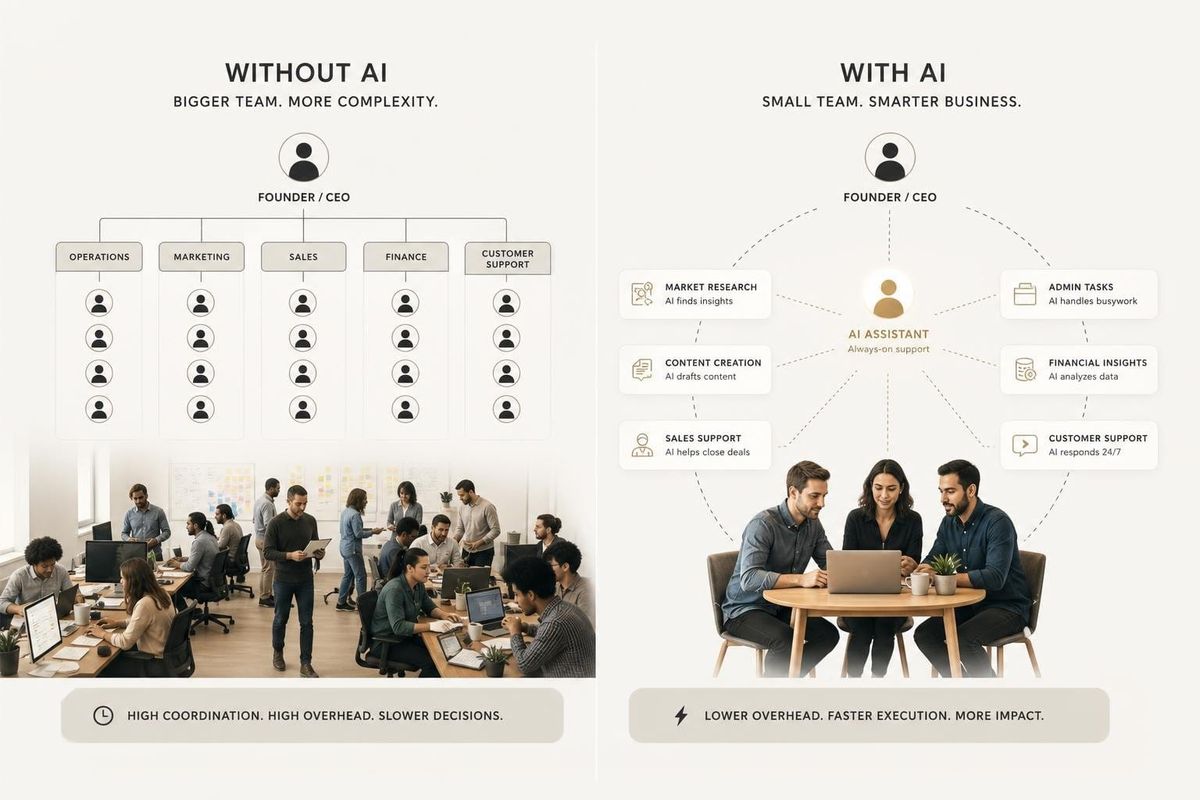
Five years ago, if you wanted your small business to produce the volume of content, research and internal process work that a proper enterprise team could, you basically needed to hire. There was no way around it. Either you did everything yourself, slowly, badly, at the expense of the things that actually grew the business, or you built a team.
That has changed. I'd argue it's the most practically significant shift I've seen in 25 years of running businesses, and I say that as someone who wasn't especially early to it and spent longer than I should have being sceptical.
The case I want to make here isn't that AI makes you more efficient. Efficiency is the wrong frame. The real argument is about what becomes possible that wasn't possible before.
When I think about what used to eat the hours in a lean operation, it falls into a pretty recognisable pattern:
- Content production, whether product copy, emails, blog posts, FAQs, social
- Research, the kind where you need a solid first pass before you can think clearly about a decision
- First drafts of anything
- Repetitive internal work, formatting reports, summarising things, turning raw notes into something usable
- The cognitive overhead of tasks that matter but don't deserve your full attention, the things you end up doing yourself because they're not quite important enough to hand off properly, but they quietly consume an hour here and two hours there
That is a lot of work. And most of it, until recently, required a person.
What AI actually does well is volume work on defined tasks. Give it a clear brief, a real input and a specific output format, and it produces a credible first draft faster than any human. It doesn't decide what to write. It doesn't know which angle matters, or what your customer actually cares about, or whether the tone is right for your brand. That's still you. But the gap between a blank page and something you can work with has collapsed, which means the time you spend on content and research is now time spent editing and improving rather than starting from nothing.
And that last point matters more than people give it credit for. A human still needs to check the output, especially for anything going in front of a customer. AI doesn't catch its own blind spots, doesn't know when the tone has drifted slightly off, and isn't accountable for a mistake the way a person is. The workflow only works if someone with editorial judgement is at the end of it. That's the part you don't hand over.
I run Martian Made with a lean team. I also built TigerAvocado within the AvocadoAI company, and every system we offer has to run inside Martian Made first. If it doesn't earn its keep in a live seven-figure business, it doesn't go anywhere else. That's the filter. So when I say AI has meaningfully changed what a small team can output, I'm not theorising about it.
The more honest version of that is this: AI doesn't replace judgement, and it doesn't replace relationships, and it certainly doesn't replace the kind of accumulated experience that tells you which problems are worth solving. What it does is take the volume work off your plate so that your judgement, your relationships and your experience get more airtime.
Now, a fair counter to all of this is that most businesses adopting AI aren't actually doing very much with it. The British Chambers of Commerce ran a survey earlier this year and found that only around 11% of businesses are using AI to a great extent to automate or streamline operations. The majority are still at the "I've played with ChatGPT a few times" stage, which is genuinely fine, but it's also not what I'm describing.
The minority that have actually built AI into how they work, properly, with real workflows and real outputs they depend on, that group is operating at a different level. The gap between what a two-person team can produce and what an enterprise team can produce has narrowed in a way that would have sounded like exaggeration a few years ago. Not closed, to be clear. But narrowed enough that it changes the calculation around headcount, around what you take on, around how much of your own time you give to work that isn't really founder-level work.
I think a lot of small business owners are still waiting to see how this settles before they commit. That's understandable. There's a lot of noise, a lot of people selling the dream version of AI productivity, and it can be genuinely hard to know where to start. My advice, if you want it, is to start somewhere boring. Pick one thing in your business that is important but not intellectually interesting, something you do regularly, something that has a clear input and a clear output, and try to build an AI workflow around that one thing. Not a revolution. Just the one thing.
Keep a human in the loop at every stage that touches something external. A customer email, a product listing, a blog post: all of these need a final editorial pass from someone who actually knows the brand. The AI gets you 80% of the way there quickly. The last 20% is still yours, and it should be.
Because the compounding effect of getting that one thing off your plate, and then the next one, and then the next, is actually where the gap opens up. It's a bit like the way seasoning works in cooking: each individual layer doesn't seem to do that much, but by the time you've done it properly all the way through, the difference is enormous and you can't quite point to where it happened.
If you'd rather have someone build those workflows for you than figure it out yourself, that's exactly what the team at AvocadoAI does for small businesses. You can find them at www.avocadoai.co.uk.
What's on your plate right now that a well-briefed AI workflow could handle better than you can afford to?